FSM to check divisibility by 5
Question
Design an FSM that checks whether a number is divisible by 5. Bits arrive serially, one per clock, MSB first. Assert an output when the number received so far is divisible by 5. How many states, why, and what are the transitions?
Key idea
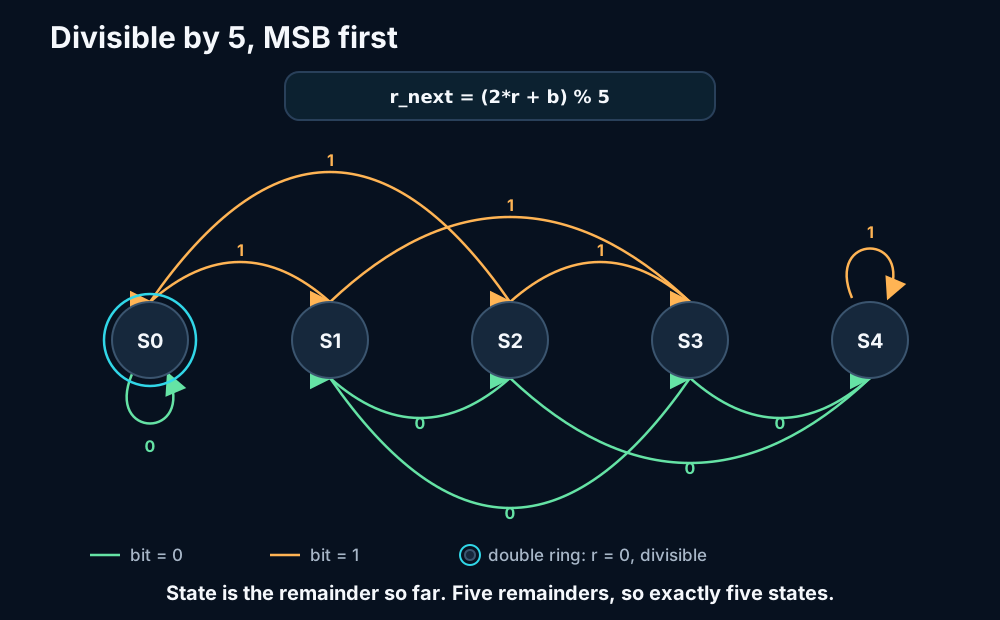
Appending a bit MSB-first turns the value N into 2*N + b, and divisibility only depends on N % 5, so a state need hold nothing but the remainder. Five possible remainders means exactly five states, with r_next = (2*r + b) % 5.
Answer
This is not a sequence detector. It is arithmetic: each new bit shifts the accumulated value left and lands in the ones place, so N -> 2*N + b. Since N is unbounded you cannot store it, but you do not need to — only N % 5 matters, and modular arithmetic distributes over both the multiply and the add.
Let state Sr mean “the value so far leaves remainder r”. Reset to S0.
| State | bit 0 | bit 1 |
|---|---|---|
| S0 | S0 | S1 |
| S1 | S2 | S3 |
| S2 | S4 | S0 |
| S3 | S1 | S2 |
| S4 | S3 | S4 |
module div5 (input logic clk, rst, inp, output logic oup);
  typedef enum logic [2:0] {S0, S1, S2, S3, S4} state_t;
  state_t state;
  logic   valid;

  always_ff @(posedge clk) begin
    if (rst) begin
      state <= S0;
      valid <= 1'b0;
    end
    else begin
      valid <= 1'b1;
      case (state)
        S0:      state <= inp ? S1 : S0;
        S1:      state <= inp ? S3 : S2;
        S2:      state <= inp ? S0 : S4;
        S3:      state <= inp ? S2 : S1;
        S4:      state <= inp ? S4 : S3;
        default: state <= S0;
      endcase
    end
  end

  assign oup = valid && (state == S0);
endmodule
Moore or Mealy is a design choice, not a property of the problem. oup = (state == S0) is Moore: registered, glitch-free, but reporting on bits through the previous cycle. oup = (next_state == S0) is Mealy: valid in the same cycle the bit arrives, matching the wording of the question, at the cost of a combinational path from inp to the output. State and transition logic are identical either way.
The arithmetic form generalises and is cheaper than the case statement:
  logic [3:0] sum;
  assign sum = {state, 1'b0} + inp;   // 2*r + b, at most 9
  always_ff @(posedge clk)
    if (rst) state <= '0;
    else     state <= (sum >= 5) ? sum - 4'd5 : sum;
Cost
Five states, so 3 state bits. The arithmetic version is one 4-bit adder plus one mux — the compare and the subtract share an adder, since sum + 4'd11 produces sum - 5 in its low bits and the sum >= 5 condition in its carry-out.
Five is the true minimum: all five remainders are behaviourally distinguishable, so no two can be merged.
Gotchas
- Never write
% 5in RTL — a general modulo infers a divider. Because2*r + b <= 9 < 10, a single conditional subtract of 5 always suffices. - Always include a
defaultin the statecase. With 3 bits encoding 5 states, values 5 to 7 are unreachable in theory but leave the FSM with no assignment, so it holds its value forever. In simulationstateis3'bxxxbefore reset, matches nothing, and staysxindefinitely. S0means both “remainder 0” and “nothing received yet”, so a bare Moore output asserts out of reset and claims the empty stream is divisible. Qualify it with avalidbit.- Set that valid bit unconditionally (
valid <= 1'b1), not withvalid <= valid | inp. The latter tracks “have I seen a one”, so a stream of zeros never reports divisible — but zero is divisible by 5. - Verilog syntax traps that bite here:
if (rst) begin ... endneeds itsendbeforeelse, and with ANSI-style ports you must not re-declare the ports in the body. - Verify a trace against the arithmetic, not against your own table.
1010is 10, so the machine must finish inS0.
Follow-ups
- Bits arrive LSB first. Different machine, 20 states — see the LSB-first variant.
- Divisible by any N. Same skeleton with N states and
r_next = (2*r + b) % N. The single conditional subtract still works because2*r + b < 2*N. - Output the remainder instead of a flag. Already there: the state encoding is the remainder, so just expose it.
- Divisible by a power of two. Degenerate — inspect the low bits, no FSM needed.
- Divisible by 3.
r_next = (2*r + b) % 3, three states.