FSM to check divisibility by 5, LSB first
Question
Same divisibility-by-5 checker, but bits now arrive LSB first — on cycle k you receive the bit of weight 2^k. What replaces the 2*N + b relation, what must a state hold, and how many states do you need?
Key idea
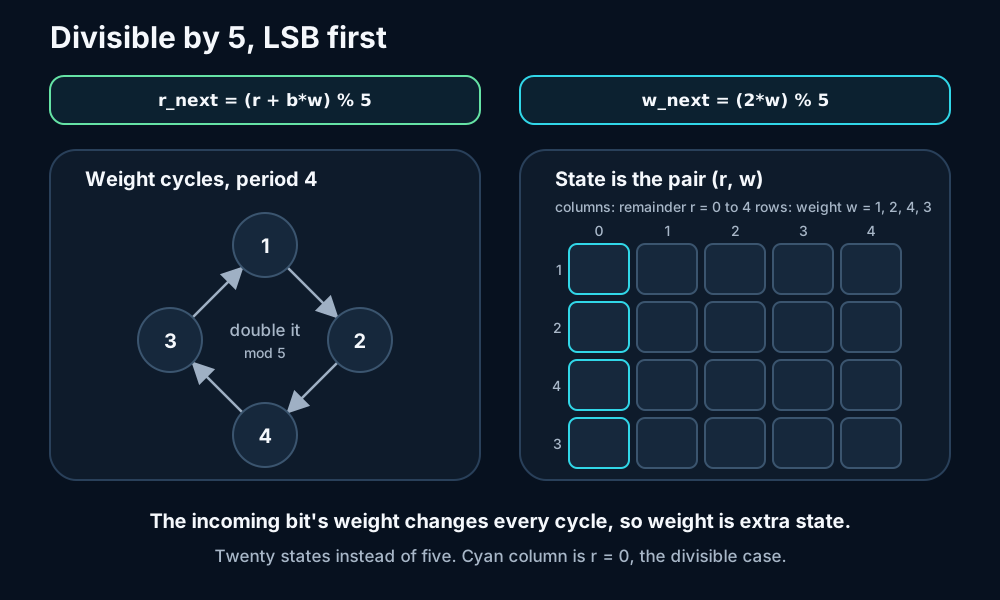
LSB-first, the bits you already hold never move; instead each new bit lands one position higher, so N -> N + b * 2^k. The remainder alone can no longer predict the next remainder because the bit’s weight depends on k, so state becomes the pair (remainder, weight) — and since 2^k % 5 has period 4, that is 5 * 4 = 20 states.
Answer
Compare what each direction needs in order to compute the next remainder:
| Arrival order | Value relation | Needs |
|---|---|---|
| MSB first | N -> 2*N + b |
remainder only, 5 states |
| LSB first | N -> N + b * 2^k |
remainder and weight, 20 states |
MSB-first the doubling acts on the accumulated value, which is computable from the remainder. LSB-first the scaling acts on the incoming bit, and the remainder tells you nothing about what the next bit is worth. Concretely: with r = 0 and an incoming 1, the new remainder is 1 at cycle 0, 2 at cycle 1, and 4 at cycle 2. Same remainder, same input, three outcomes — so they must be three distinct states.
The weight does not grow without bound, because only 2^k % 5 matters and that repeats:
2^0=1, 2^1=2, 2^2=4, 2^3=8->3, 2^4=16->1, ...
so w cycles 1, 2, 4, 3 with period 4, and each weight is the previous one doubled mod 5. That is one small register, not a lookup table.
module div5_lsb (input logic clk, rst, inp, output logic oup);
  logic [2:0] rem;    // N % 5:     0..4
  logic [2:0] wgt;    // 2^k % 5:   1, 2, 4, 3
  logic       valid;
  logic [3:0] acc, dbl;

  assign acc = rem + (inp ? wgt : 3'd0);   // at most 4 + 4 = 8
  assign dbl = {wgt, 1'b0};                // at most 2 * 4 = 8

  always_ff @(posedge clk) begin
    if (rst) begin
      rem <= 3'd0; wgt <= 3'd1; valid <= 1'b0;   // 2^0 % 5 = 1
    end
    else begin
      rem   <= (acc >= 5) ? acc - 4'd5 : acc;
      wgt   <= (dbl >= 5) ? dbl - 4'd5 : dbl;
      valid <= 1'b1;
    end
  end

  assign oup = valid && (rem == 3'd0);
endmodule
Trace 10, whose LSB-first bit stream is 0, 1, 0, 1 against weights 1, 2, 4, 3: the remainder goes 0, 0, 2, 2, (2+3)=5 -> 0. Ends at 0, and 10 is divisible by 5.
Cost
Twenty states, encoded as two registers rather than a flat 20-way case — rem is 3 bits and wgt is 3 bits, a product encoding. All 20 are reachable and pairwise distinguishable (two states with equal remainder but different weight diverge after a single 1), so 20 is minimal.
Each update is one 4-bit adder plus one mux. b * w is not a multiply: b is one bit, so it is a mux, or equivalently {3{inp}} & wgt.
Gotchas
N + 2*bis the wrong relation. The weight is not a constant 2, it is2^kand it grows every cycle.- Both updates stay in range for a single conditional subtract because
r + b*w <= 8and2*w <= 8, both under2 * 5 = 10. That is the general rule: one subtract suffices wheneverx < 2*M. wgtmust reset to 1, not 0. A zero weight is an absorbing state and the remainder would never change again.{wgt, 1'b0}for2*wstates the 4-bit width outright.wgt << 1works here only because of Verilog’s context-determined width rules for shifts — the concatenation removes the need to reason about it.- The 4-bit
accanddblassigned back into 3-bit registers is safe (post-subtract values are at most 4) but will raise a lint width warning. Slice explicitly if you want it clean.
Follow-ups
- Why is MSB first cheaper? General fact about serial arithmetic, not special to 5: appending at the LSB end is a fixed multiply-by-radix that folds into the state, while LSB-first forces you to carry positional weight.
- Four bits at a time. Since
2^4 = 16is congruent to 1 mod 5,N % 5equals the sum ofN’s hex digits mod 5 — accumulate nibbles with no weight tracking at all. This is the base-16 cousin of summing decimal digits to test divisibility by 9. - Divisibility by N, LSB first. State count is
Ntimes the multiplicative order of 2 modN. For 5 that order is 4; for 3 it is 2, giving only 6 states. - Why does the weight cycle at all? 2 is invertible mod 5, so repeated doubling walks a cyclic subgroup and must return to 1.