Basic gates from a 2:1 mux and from NAND
Question
Build NOT, AND, OR, XOR, NAND and NOR using only 2:1 multiplexers, and separately using only NAND gates. Why is a 2:1 mux functionally complete, and what is the minimum NAND count for XOR?
Key idea
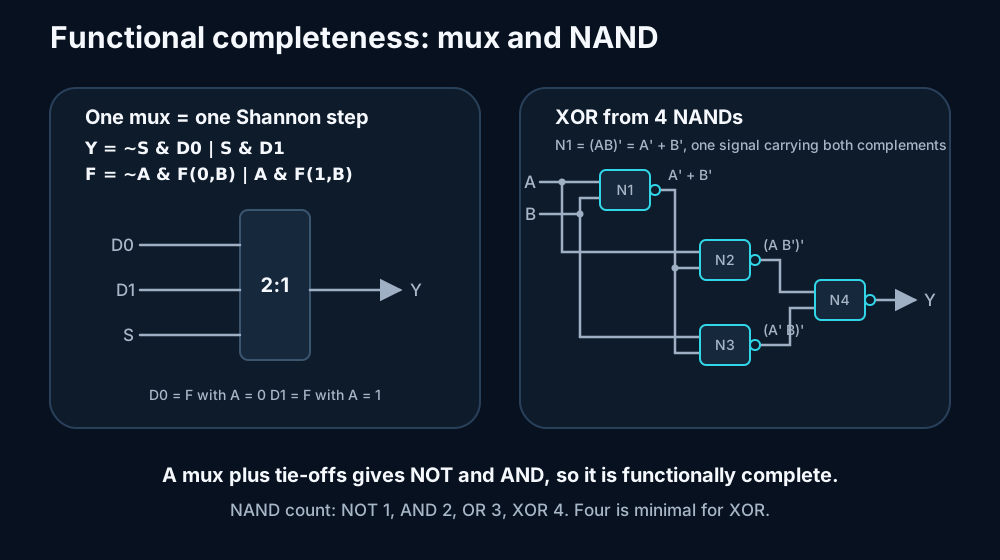
A 2:1 mux computes Y = ~S & D0 | S & D1, which is exactly Shannon’s expansion F = ~A & F(0,B) | A & F(1,B). So drive S with A and the data inputs are just F with A forced to 0 and to 1 — read off, never guess. For NAND, massage the expression until its outermost operation is a complemented product, because that shape is a NAND.
Answer
From 2:1 muxes
With Y = S ? D1 : D0, substitute A = 0 and A = 1 into the target function and read off the cofactors:
| Gate | S | D0 = F(0,B) | D1 = F(1,B) | muxes |
|---|---|---|---|---|
| NOT | A | 1 | 0 | 1 |
| AND | A | 0 | B | 1 |
| OR | A | B | 1 | 1 |
| NAND | A | 1 | B’ | 2 |
| NOR | A | B’ | 0 | 2 |
| XOR | A | B | B’ | 2 |
The split is entirely explained by the cofactor column. The cheap three need only 0, 1, or the bare wire B — all free. The expensive three need B', a complement, which is not a free signal and costs the second mux. Swapping which variable drives the select does not rescue you: expand NAND on B instead and the cofactors are 1 and A', still a complement.
Generalising: with S = A and each data input drawn from {0, 1, B}, one mux realises 9 of the 16 two-variable functions. The other 7 all need a complemented input. If both polarities are already available — common in real silicon, since a flop gives you Q and Q' — all six collapse to a single mux.
From NAND gates
| Gate | Construction | NANDs |
|---|---|---|
| NOT | NAND(A,A), since A·A = A |
1 |
| AND | NAND(A,B) then invert |
2 |
| OR | NAND(A', B') = (A'·B')' = A + B by De Morgan |
3 |
| XOR | see below | 4 |
| NOR | OR then invert | 4 |
The minimal 4-gate XOR, where the trick is that N1 is a shared term used twice:
| Gate | Expression | Simplifies to | Why |
|---|---|---|---|
| N1 | NAND(A,B) |
A' + B' |
De Morgan |
| N2 | NAND(A, N1) |
(A·B')' |
A(A'+B') = 0 + A·B' |
| N3 | NAND(B, N1) |
(A'·B)' |
B(A'+B') = A'B + 0 |
| N4 | NAND(N2,N3) |
A·B' + A'·B |
De Morgan on the output |
N1 = (AB)' = A' + B' is one signal carrying both complements at once. ANDing it with A annihilates the A' term and leaves A·B'; by symmetry B leaves A'B. The naive sum-of-products route costs 5 because it builds A' and B' as two separate single-use signals; the fully literal AND-OR translation costs 9.
Four is the proven minimum. By duality, swapping every NAND for a NOR in that table yields XNOR in 4 NORs.
Why a mux is functionally complete
Two arguments, both worth having.
Reduction. One mux gives NOT (D0=1, D1=0) and one gives AND (D0=0, D1=B). {NOT, AND} is a complete basis, therefore the mux is complete. Three lines.
Structural. One mux is one Shannon expansion step, consuming one variable and leaving two functions of n-1 variables on its data inputs. Recurse: after n levels the data inputs are functions of zero variables, i.e. constants. So any n-input function is a binary mux tree of depth n with 2^n - 1 muxes and 2^n constant leaves — which is precisely an FPGA lookup table. A 4-LUT is a 16:1 mux whose data inputs are SRAM cells holding the truth table.
Cost
Mux counts: NOT 1, AND 1, OR 1, NAND 2, NOR 2, XOR 2. NAND counts: NOT 1, AND 2, OR 3, XOR 4, NOR 4. An n-input function needs 2^n - 1 muxes as a tree.
In CMOS a NAND is 4 transistors while an AND is 6 (NAND plus inverter), which is why NAND-based logic is the cheap default.
Gotchas
- The completeness proof requires tie-offs to 0 and 1. A 2:1 mux with all three inputs driven by variables is not functionally complete: feed all ones and you get 1, feed all zeros and you get 0, so it is both 0-preserving and 1-preserving, and no circuit of such gates can ever produce NOT. Say “complete over the basis including constants” and you are answering above level.
- In the 4-NAND XOR,
N2andN3are the complements of the product terms, not the products. That is the point — the final NAND expands by De Morgan toN2' + N3', which un-inverts and ORs them in one gate. “Isn’t N2 inverted?” is the standard follow-up. - Derive cofactors by substitution, not intuition. Guessing is where people lose XOR and NOR under pressure.
- “Muxes can build any gate, and FPGAs use muxes” restates the claim rather than proving it. The FPGA fact is a consequence of Shannon completeness, not evidence for it.
Follow-ups
- Build a 4:1 mux from 2:1 muxes. Three of them, two levels — one Shannon step per select bit.
- Is NOR functionally complete? Yes, dual argument: NOR gives NOT and OR.
- Why are LUTs mux trees? The recursion above. You change the function by rewriting the SRAM leaves rather than rewiring anything.
- Cheapest XOR in CMOS? Not the 4-NAND version — a transmission-gate XOR is 6 transistors.
- 2:1 mux from NANDs? Four, same count as XOR.