Reverse a singly linked list
Question
Reverse a singly linked list. Give the iterative solution and the recursive solution, state time and space complexity, and make the empty list and the single-node list both work.
Key idea
Rewiring a node backwards overwrites curr->next, which is the only pointer to the rest of the list, so it has to be saved first. Ship the iterative version: three pointers, O(1) space, and return prev, which ends up on the old tail.
struct Node { int data; Node* next; };
Answer
Iterative
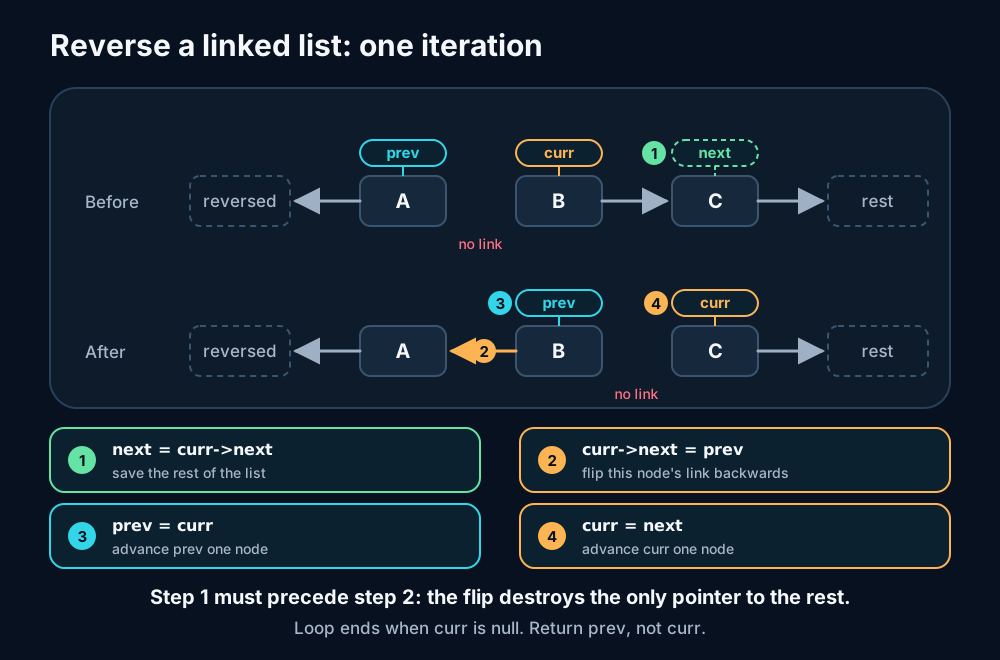
Node* reverse(Node* head) {
    Node* prev = nullptr;
    Node* curr = head;
    while (curr) {
        Node* next = curr->next;   // 1. save the rest
        curr->next = prev;         // 2. flip this link
        prev = curr;               // 3. advance prev
        curr = next;               // 4. advance curr
    }
    return prev;                   // old tail is the new head
}
The order of those four lines is the problem. Line 1 exists only because line 2 destroys the forward pointer. Mid-loop the list is genuinely severed between prev and curr, which is what forces the save.
Boundaries need no special-casing. An empty list skips the loop and returns nullptr. A single node runs once and returns itself. The old head becomes the tail with a null next, because prev starts null.
Recursive, classic
Rewires while unwinding. This is the version most interviewers have in mind.
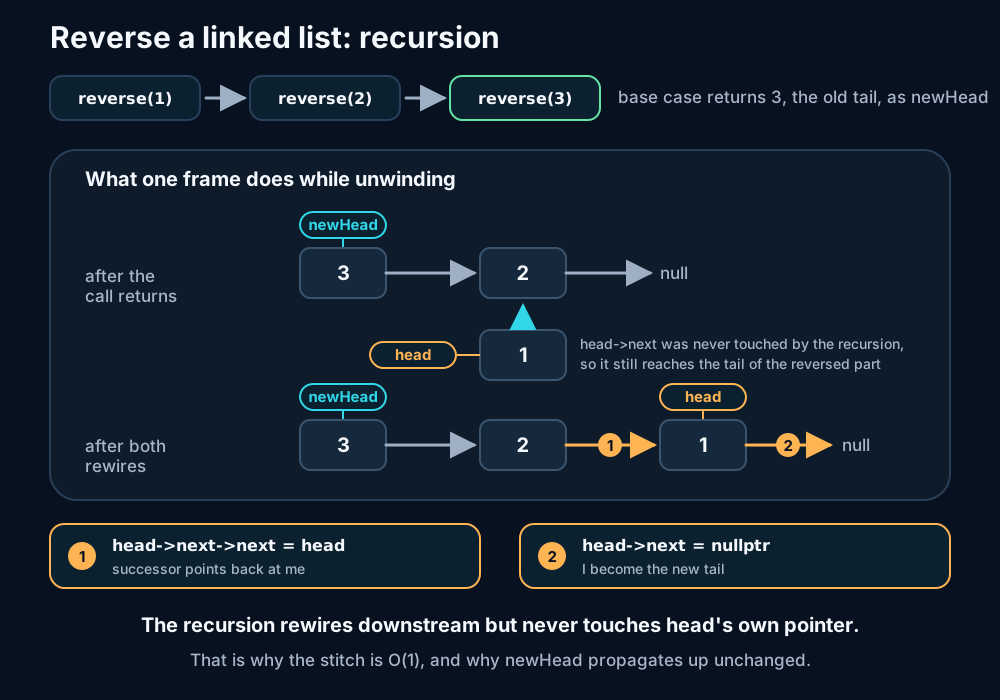
Node* reverse(Node* head) {
    if (!head || !head->next) return head;   // 0 or 1 node
    Node* newHead = reverse(head->next);
    head->next->next = head;   // successor points back at me
    head->next = nullptr;      // I become the tail
    return newHead;
}
The load-bearing insight: after the call returns, the sublist from head->next onward is fully reversed and the node originally at head->next is now its tail. Because the recursion rewires only downstream and never touches head’s own pointer, head->next is still a valid handle on that tail — which is what makes the stitch O(1).
Note head == nullptr is reachable only on the very first call; inside the recursion head->next == nullptr catches the last node one step early. It is purely an empty-list guard.
Recursive, accumulator
No diagram, because the mechanism is identical to the iterative version — that equivalence is the thing worth remembering. Each call saves next, rewires backwards, and advances both pointers; the only difference is that the advance is a function call instead of a loop increment.
Node* reverse(Node* curr, Node* prev = nullptr) {
    if (!curr) return prev;
    Node* next = curr->next;
    curr->next = prev;
    return reverse(next, curr);
}
The base case if (!curr) return prev; does three jobs at once: it terminates, it handles the empty list without dereferencing, and prev is the answer, because falling off the end leaves it on the last node. Recursing one step onto the null pointer is what buys all three.
This one is genuinely tail-recursive — the call is the last thing the function does — so GCC and Clang at -O2 collapse it into the loop above.
Cost
| Version | Time | Space | Tail position |
|---|---|---|---|
| Iterative | O(n) |
O(1) |
— |
| Accumulator recursive | O(n) |
O(n), O(1) if TCO |
yes |
| Classic recursive | O(n) |
O(n) |
no |
Ship the iterative one. Tail-call elimination is not guaranteed by the standard, so claim O(n) stack and offer O(1) only as a compiler optimisation.
Gotchas
- Save
curr->nextbeforecurr->next = prev. Reverse those and everything pastcurris unreachable. prevmust startnullptr, nothead. Otherwise the old head keeps pointing at the second node while the second points back at it, creating a two-node cycle.- In the classic recursive form,
head->next = nullptris strictly needed only in the outermost frame — inner frames have it overwritten by their parent. Doing it uniformly is correct and simpler. Dropping it entirely gives you the cycle above. - The classic recursive version is not tail-recursive: three statements follow the call, so the frame must survive it and
O(n)stack is unavoidable. - Assert the old head’s
nextis null afterwards. The cycle bug makes a print-traversal hang forever; Floyd’s tortoise and hare catches it. - Test empty, one node, two nodes (the smallest case where order changes), and one odd and one even length.
Follow-ups
- Reverse in groups of k. Confirm
knodes exist before rewiring, since you cannot back out mid-flip. A dummy node ahead of the head keeps the stitching uniform, because each group’s old head becomes its new tail. - Reverse a sublist between positions m and n. Same dummy-node technique.
- Palindrome check. Find the middle with slow/fast pointers, reverse the second half, compare.
- Detect a cycle. Floyd’s tortoise and hare — the assertion that catches the
previnitialisation bug above. - Doubly linked list. Swap
nextandprevon every node and swap the list’s head and tail.